Showing posts with label winning. Show all posts

Thursday, November 3, 2016

Losing and the Aftermath

I'm a proud fan girl.
This morning, the day after the Cubs won the 2016 World Series, I wake up a Cleveland Indians fan. And not only a fan, but a season ticket-holder who attended every home playoff game of the 2016 post-season. In person, I watched my team battle against the odds and the injuries and win its first two series only to lose after leading three games to one, in an epic battle in Game 7 of the World Series - a game that will go down in history as one of the greatest game sevens ever.

It was devastating and heartbreaking and frustrating and all of those things at once. But it got me to thinking. Who am I most heartbroken for? Myself? Not really. I'm still a fan. Do I feel sorry for Cleveland? Kind of. We all have to get up this morning feeling like "we" came THIS CLOSE to greatness but ended up back in Cleveland, often called the "mistake on the lake." Do I feel sorry for the players?

Absolutely.

And I know that they probably all get on airplanes and go back to their homes and families in different parts of the country and don't have to live here with the disappointment of another failed championship. They get their huge paychecks and forget about it, right?

Except, based on everything I've witnessed and read and heard, I don't think that's really the case with this team. They are much more than working professionals collecting a paycheck. They're a TEAM.

And I empathize with them because I've been a competitive athlete my whole life. I grew up in a competitive athletic family, and I know what sports disappointments are all about. I know that football losses ruin Thanksgiving dinners. I know that injuries ruin track seasons. I've cried over many of these things, not only for myself, but for my high school teams and my college teams. And I know the heart of an athlete. I know what our Cleveland Indians players are feeling right now. And I know that they will take this with them into next season and it will haunt them.

It will haunt them because of HOW CLOSE it was. I think a blow-out would have been easier to handle. I know this because I, too, came THIS close to a championship and it still haunts me to this day. When I was a senior in high school on the swim team, I lost a state championship by one-tenth of a second. I always wondered what my life would be like had I won. Would people have treated me different? Would I have liked myself better?

I will never know. But I do know that my feelings for the Cleveland Indians have not changed.

And it makes me realize that, as athletes, we do what we do because we love it. We come back the next year and try again. It took a long time for me to get back to the sport I truly love, but I swim now and I keep pushing my limits.

And it also makes me realize that we should never, as I have done in the past, let our sports performances define us or tell us whether we are worthy or not. And I will not judge professional athletes on whether they win championships or not. They can be heroes to us for so many more reasons. For making us realize the human potential. For taking us back to the kid inside us. And for their charitable contributions and actions. Those are the important things they give us.

And those are the things we should recognize in ourselves.

Thursday, September 11, 2014

Never Too Old To Rev: 2014 Rev3 Cedar Point

Podium.
A few weeks before the ITU World Champs in Edmonton, my concern turned to the fact that I had no long races coming up to test the waters after all the Ironman training I've been putting of my body. Having a recent 70.3 would be a good test - if only for the racing experience. My last one was great, but it was all the way back in May. But with no more vacation hours left in my work schedule, I knew it would have to be close to home and do-able in a weekend. I hoped I could find something reasonably competitive.

As they say, be careful what you wish for. The race that fit the bill was the Rev3 Cedar Point half in Sandusky, Ohio. At an hour-twenty-minute drive from my house, I declared my intentions, checked schedules with my husband Jim, and registered. I've always had this race in my sights because of its location, the quality of the brand, and the local support - and friends and teammates would be there. The problem was that it always fell on the same weekend as other races that I'd rather do. And, this year.. well, yeah, it was only six days after Edmonton - but I really expected I'd recover in time.

What I didn't expect was that I'd be less than pleased with my race in Edmonton and that I would punish myself with some blisteringly-long and hard workouts as soon as I walked off the plane. (Yes, I do that.) When I registered for Rev3, I was planning a reduced week of training leading into a good race experience. At the very least, I wanted a boost in my confidence and to know all this ridiculous training was working.

So... after beating myself up all week, I was dealing with extreme soreness in my quads that refused to subside by race morning. And to complicate things, my Saturday night Indians game commitment resulted in dinner at Denny's (I'm not proud, I ate eggs and cheese on toast with hash browns AND fries - don't judge me) and getting to sleep around 2 am (because I was second-guessing everything I did leading up to this race).

Jim and I rolled out of bed at 4:45 am, and, despite the lingering muscle soreness, I actually didn't feel bad enough to reconsider the whole thing (there was a distinct possibility that I would just go pick up my bike and slink away quietly with my tail between my legs). The weather made everything a lot nicer - it was a little windy, but skies were clear and air temperature was in the 60s, and it sure beat the hand- and feet-numbing 40s we had in Edmonton.

At Cedar Point, Rev3 hosts both a half and a full iron-distance race the same day. The full distance athletes had already started their swim at 7 am. The half started at 8:30, and my wave (women 40+ and relays) were at 8:50.

My wave - we're faster than you think.
I set up transition, then met up with Jim to walk down the beach to the start. Strangely, my normal pre-race jitters where nowhere to be found. Which was odd, because local races usually produce severe performance anxiety knowing friends and colleagues will be "watching." I ran into two of my teammates on the way to the swim start, and we went for a quick warm-up in the water (or "surf" as it was).

The water was quite rough that morning. It reminded me of the Atlantic Ocean along my beloved New England coast on a good beach day. The 1.2-mile swim course was trapezoidal - with swimmers going out against the current, then turning parallel to the shoreline, and finishing with the waves.

We started in waist-deep water, and it took me a minute or two to get a breathing rhythm going, but after that, the only problems I had were in spotting buoys between the swells. I had to stop a few times, but the course was well marked with huge yellow and orange buoys, so they were quick to spot once I stopped. People were mostly swimming alone because of the conditions - we got kinda scattered in the surf.

The rough water made all the swim times slow, but what I CAN say about the first leg of Rev3 Cedar Point was this: in all my years of triathlon racing, this was THE most fun I've ever had in a swim. It was a blast. It wasn't so choppy that I was afraid, and it was just challenging enough to feel like I had to be a good swimmer in order to navigate it. After the race, someone on Facebook posted that 60 swimmers either bailed or had to be pulled out for safety. That surprised me, but volunteers and officials on the swim course were very vigilant, and they certainly had some work to do that day.

The slowest part of the swim for me was plodding out of the water on a long sandbar. But the run to transition was short and sweet, and I was on my bike in a little over a minute. My watch recorded 32 minutes and change for my swim time.

Bike finish through Cedar Point parking lot.
The 56-mile bike course started out along the causeway to Cedar Point and continued along the Lake Erie shoreline for several miles before turning south and going through a slightly-rolling rural countryside. I rode mostly alone with a small group of leap-froggers. The wind slowed me down a bit, but I maintained a steady hard effort that put my speed around 20-22 mph. At 2:38, my bike time was slower than I would have liked on what seemed like a fast course.

Coming off the bike, I had no idea where I was in the grand scheme of the women's race, but when I came out of the swim, Jim let me know I was the first woman in my wave. Two women younger than me passed me on the bike, so there was a good chance I was leading the age group going into the run. All I wanted at that point was to have a solid, even-paced run.

What I didn't know was that I came off the bike within 9 minutes of the overall women's leader. (Had I known that, I still may not have changed my strategy of a steady-split half-marathon.)

The Cedar Point 13.1-mile run course was mostly flat, without shade, and with a lot of turns. The only "hill" came in mile 2 and 12. During the run, temperatures warmed up into the high 70s-low 80s. By mile 2, I was dumping ice down my top.

I went out in a surprisingly-comfortable 7-minute pace. In the first four miles, I caught one of the women who passed me and was catching the second one. By mile 6, she and I were running together hanging on to a 7-7:15 pace. It was actually nice to have someone to chit-chat with. Her name was Erin, she was from Chicago, and she was coming back from an injury. We ran together, pushing each other to go faster than I suspect either one of us would have done alone.

Around mile 9, my pace was slowing more than I wanted it to, and I needed to pick it up a bit. I surged and Erin hung back. I worried it was too soon and I would eventually die hard, but it was only four miles to go. Besides, all the women I passed had started in the wave five minutes ahead of me, so I had to die really hard to lose my place (believe me, I'm not stupid, I realize this was not beyond the realm of possibility). If I made a mistake, at least I would learn something, and I wasn't making it in my most important race.

A few moments after I picked up the pace, a woman running in the other direction yelled to me that the leader was four minutes ahead. It seemed very precise, and I wasn't sure whether to trust her time measurement or not - or even if it was the "leader" she was referring to. But if she was right, I had a shot at winning this thing. I tried to push that thought out of my mind. I may have just made the mistake of my life by surging too soon. I may have blown out anything left in my legs. And NOW you tell me I can win this thing?!

Run finish
Oh, for cryin' out loud! I mentally regrouped... at this point in my life, I know how rare these chances are. And I could not leave it up to chance timing. I now had to exercise mind over matter because my already-sore legs were really starting to burn and my energy was waning. Somehow, I pushed through the last three miles while slowing and feeling increasingly worse. I even had to walk the second-to-last aid station. With about a mile to go, a relay guy said: "She's gaining on you" (and pointed behind me to Erin - who was catching back up). I told him I had a five-minute lead on her.

Then it hit me - that was NOT the attitude to take into the last half-mile of a race. I imagined I was on Ali'i Drive. I had to defend my lead - my surge - or die trying. I focused my brain, and headed for the finish line. When I turned toward the finish chute and saw Jim, he looked at his watch and said definitively, "You won!"

There was no fanfare or name-announcing... because I was actually the "second woman to cross the finish line." I forgot to hit the stop button on my watch and looked up at Jim in concern. Are you sure? I congratulated Heidi Benson - the young woman who crossed three minutes in front of me (unfortunately, the Rev3 announcer mistakenly assumed she won the race), and then we waited.

About ten minutes later, the announcement came: assuming no penalties, I had won the women's race - and finished tenth overall. Jim had me at 4:51, but the official time was 4:50:54.

With this unexpected turn, we definitely stuck around for the podium and the swag (which blows away anything I ever got from Ironman podiums). We celebrated with the overall men's winner, local standout and super nice guy Nick Glavac, and my SSSMST teammates Mike Schaefer (5th AG 40-44) and Brian Stern (5th overall an 1st AG 45-49).

SSSMST teamies: Mike Schaefer (center), Brian Stern (right)
I was never so glad I entered a race. It may have been just the pick-me-up I needed to get through the final month of Kona training.

Wednesday, July 2, 2014

Don't Freak Out: Ironman Coeur d'Alene 2014

One of my favorite things to see at Lake Coeur d'Alene:
Seaplanes!
Sometime last year (I can't remember when), my husband Jim said something akin to: "If you're going to do another Ironman, we should go back to Coeur d'Alene." In considering this, I'm not sure we fully appreciated, or recalled - exactly - what happened last time we were in Coeur d'Alene.

It was 2009. I was 44 years old. It was my first attempt at the Ironman distance (2.4-mile swim/112-mile bike/26.2-mile run) in six years. In my previous attempt - 2003 - I had dropped out of Ironman Florida. Thus, in 2009, the goal was to finish. But I don't remember anything after mile 20. Wait, I don't remember anything after mile 15. I can go back and read my race report to pull out details, but here's the short version: it was an eleven-mile descent into hypothermia-fueled delirium.

Photographic evidence of my 2009 run to the finish
I DO remember a medic stating my temperature had fallen to 90.3 degrees F. After that I was in a tunnel. People were talking to me, asking me questions, but my responses didn't seem to be getting back to them. The next thing I remember was sitting up shivering and being fed warm fluids (once my temperature had INcreased to 97 degrees, I could "shiver" again). When they finally let me out into the arms of the J-Team - Jim and my friend Julie - it was dark outside. I had no idea how much time had passed. On the way back to the hotel, Julie said: "Jim stood out in the rain for 2.5 hours waiting for you. No one would tell us anything."

2.5 hours. Gone. Lost. Did I even finish? Did Mike Reilly say my name?

Indeed. I had become an Ironman for the second time. Jim had the evidence - my medal. And there was photographic evidence as well.

This time, the only thing I sought in Coeur d'Alene was to see that finish line and remember it. Because Coeur d'Alene is such a beautiful place to traverse 140.6 miles. And the community is so supportive. And I DON'T remember it.

But, crikey! It was cold there. Mind-numbingly cold for a late spring/early summer triathlon. But I listened to Jim and registered anyway - extremely happy to find out the race was no longer in early June. Ironman CDA now took place at the end of June - the 29th! Surely, it would be warmer.

Get me out of this freakin' cold water.
Fast forward to Friday, June 27, 2014. Two days before race day.

Lake Coeur d'Alene was still like ice water. People were getting out saying "oh, it's not so bad, just a little choppy" -- WHAT?!?! Ok, ok, it was 61 degrees. I've been in colder water. And I'm not sure I would call it choppy. It was much choppier in 2009. In fact, IMCDA 2009 was one of my slowest 2.4-mile swims. So I gritted my teeth and swam some laps. And I got out when I could no longer feel my fingers. Did I mention the air temperature was in the 50s? Yeah. It took at least two hours for my fingers to fully regain any sensation.

Bike check on Saturday - it was sunny. 
Discussing last time with one of the volunteers.
We took to spending waking moments checking the race-day weather. And on the evening of June 28, things started to look up. The sun came out. It got warm. The wind died down. And the predicted race-day high had become 70. With lows in the mid-40s. With winds about 10mph.

That was Saturday night.

At 4:30 am Sunday morning, we headed out the door of the hotel, and the following words came out of Jim's mouth: "Don't freak out at the wind."

Don't. Freak. Out.

How bad did it have to be for Jim to worry that I would "freak out"?

It was bad. The lake would certainly be (what I would call) "choppy." Yes. I started to panic.

I was a couple hours from starting a 140.6-mile 11- to 12-hour grueling endurance event, and panic had set in before I even reached the starting line. To understand fully, maybe you had to be there in St. George in 2012. Or at Ironman Utah in 2002. Wind is a triathlete's sworn enemy. Because of what it does to the water. Because of what it does to lightweight people on lightweight bikes.

Jim reminded me that I'm a good swimmer. Friends texted me that it would be everyone's problem, not just mine. Jim also reminded me to stick with the race plan. Do NOT look at my speed on the bike and.. um.. freak out.

Race morning. Cold. Choppy.
I only glanced peripherally at the water to confirm: the chop was worse that morning than Friday. Worse than 2009. Ok. em… The water is my friend… I'm not afraid of the water... I love the water... I'm a fish... People always called me a fish... My high school swimming nickname was … fish... Don't look at the water... Everyone else will be freaking out more than me... The water is my friend… The water is my friend. The water. is. my. friend.

Why now? Why was Sunday the first time EVER that I panicked and reconsidered entering the water at an Ironman start? I've been clobbered and kicked a countless number of times in Ironman swims. I survived four-foot swells in Utah Lake for an hour. I've spent numerous hours near-suffocating in huge waves off the Cape Cod coast after thunderstorms - and enjoyed it! Why was I panicking?

I suppose I was tired of being the disaster magnet. I wanted a good weather day and a smart race. I didn't want bad weather to cause bad judgment. I went through every possible scenario of dropping out, and I couldn't come up with a good reason to walk away. So I put on my wetsuit, said goodbye to Jim, and entered the swim queue. I tried not to notice people shivering (in their wetsuits) and jumped in for a minute warm-up swim.

My thoughts? Start this thing before I start crying!

That's relief you see in my facial expression.
The 2.4-mile IMCDA swim is two loops with a short beach run between them. The swim start is now a rolling self-seeded affair - it's like a marathon start: faster swimmers up front, slower swimmers in the back. Each athlete's race started when their chip crossed the timing mat. I squeezed in with the 1:01-1:15 group and in a couple minutes, people were yelling at us that our race had indeed "started." I jumped in the water and swam immediately for the outside line.

The way out was a mess because we were swimming into the swells. I couldn't get a rhythm going with my breathing, but I was making progress even while stopping to choke on water and spot buoys. Being on the outskirts, I managed to avoid getting clobbered and the way back with the current was much smoother. I tried to "surf" the waves when I could. At the beginning of the second loop I saw 31 minutes on my watch… this was a huge surprise that put me much more at ease. I had to get to the turn, and things will get better. For the first time in a race, I noticed people grabbing onto the support kayaks. Yes, it was a rough day.

Running through transition to get warm.
I was never so happy to be out of the water. My swim took 1:04 (faster than 2009!) - although I lost any advantage by struggling through transition because my fingers stopped working in the cold. This year, I was determined to thwart the cold with wool socks, gloves, hand warmers, a bike jersey, and arm warmers. After what seemed like forever to get all these things on with numb fingers and wet skin, I sprinted for my bike. I could tell from the full bike racks that most of my age group was still in the water.

Ok, then, I had no time to lollygag. It was time to find out what this wind was all about.

Somehow I found a smile.
The IMCDA 112-mile bike course has changed three times. The last time I did it, there were some brutal hills. But now the course consists of two loops of the following: starting in downtown CDA, a short out-and-back with a tough 6%-grade hill along the lake (part of which is also the run course) followed by a long out-and-back with long (really long) rolling hills on US 95, a four-lane sometimes-divided high-traffic route. This second part went out into the wind (the Weather Underground Almanac says the max was 20 mph with gusts up to 30). A friend summed it up quite succinctly: "We were going downhill, PEDALING, at 13-14 mph." After the turn-around on US 95, we were flying, but I was never able to make up on the way back what I lost on the way out.

I'm only sharing this photo because Jim
actually managed to catch me in the middle
of a snot-rocket.
My goal on the bike was to go easy and not feel anything for the first four hours. I think something went terribly wrong with my taper because I NEVER felt good on the bike. My legs were fatigued almost from the start and my injured-but-healed hamstring was hurting like it had only been partially rehabbed. I backed way off against the wind hoping my competitors would make the mistake of going too hard. I tried to rest my legs on the downhills hoping to save something, anything, for the run. I was passed by one of my age-group competitors in the first five miles, like I was standing still, but I let her go. Seriously, this course had the potential to burn people out - even without wind.

Heading out on the second loop, I saw Jim. He raised three fingers - indicating third in my age group. I wasn't happy, but I wasn't surprised, and all I could hope was that my conservative riding would pay off. I tried to take solace in the fact my nutrition plan was causing no stomach issues whatsoever.

I was easy to spot in my SSSMST green and blue.
On the second loop, I passed one of my competitors on the steep hill - which was before the chip mat at the first turn-around. Hopefully Jim would get an update (from the Ironman tracker) I was now in second place. But it was short-lived as she re-passed me before we went back through downtown CDA. Jim gave me two fingers on the way back out, but I assured him that this was no longer the case and I was back in third place.

On the final - brutally windy - out-and-back, I played leap frog with this woman - I would pass her on the uphills, she would crush me on the downhills. I lost the battle before the turnaround, and I never caught her again. I did, however, keep an eye on my watch to determine I was still only about seven minutes down from the actual age-group leader.

I spent the last 15 miles trying not to crash - I guess I need to work on my bike-handling skills going downhill in the aero position with the wind. So far, I had seen two people being taken away on stretchers, and I still had designs on seeing that finish line no matter how bad my legs were feeling.

When I pulled into transition, I saw Jim. He said (and I quote): "great ride!" I wondered what he was smoking, as before the race, I told him I'd be happy with a 5:40 bike leg, and I was sure I had not even broken 6:30 (I did a 6:15). I was quickly reminded of the severe stiffness that accompanies Ironman T2, but I still attempted to run through it. Two awesome volunteers helped me in the change tent and had me on my way in much less time than it took in T1.

Then I saw Jim again. He gave me the (surprisingly good) news. I was three minutes behind the age group leader, currently running in third place. I asked him the most important question: "Are they RUNNERS?"

"No."

I almost broke down in tears. This was my chance. I was a RUNNER. I spent ten years learning exactly how to run a marathon, and now I needed to simply do just that.

But to do that, I needed to get my head on straight. The Ironman marathon can be undone in the first mile, and for months, I had promised myself that I would not - under ANY circumstances - go out faster than an 8-minute pace. I settled into an easy run and relaxed. Unexpectedly, the soreness and fatigue in my quads dissipated, and my spirits rose. The day had warmed a little and the sun was out.

I saw mile marker 1. I looked at my Garmin: 7:30.

I said, out loud, but to myself: "SLOW THE F DOWN."

I slowed. I took baby steps. I saw the age group leaders. I passed them both. Neither gave chase. I realized this was now my race to lose.

I saw mile marker 2. Garmin said: 7:12.

SLOW THE F DOWN!

I finally got the run under control around mile 4. I was feeling good. No stomach issues. No cold issues. I jogged the aid stations and drank Ironman Perform. As planned, I didn't drink too much. Could this possibly last?

The 26.2-mile IMCDA run course is two loops that snakes through the town before a picturesque out-and-back along the lake with the same 6% hill that's on the bike course. The turn-around is on the flip side of the hill - almost mile 7. On the way back to town I noticed I had put over ten minutes between me and second place, but my legs were starting to feel sore and cramp. My stomach was still ok, so I took a salt capsule and stuck with the plan.

After 13 miles, I started to tire of Ironman Perform and sweet gels, and I couldn't wait to get my special needs bag to change up the drink option to Gu Brew. When I got back downtown, I saw Jim. He told me I had a 15-minute lead and was running a minute-per-mile faster than everyone else in my age group. He told me NOT TO PUSH IT. Just get to the finish.

Mile 14. This marathon was more than half-finished. But my legs were starting to scream at me. And my stomach was not far behind. By mile 18, I was in a state of controlled non-vomiting. It involved walking the aid stations and stopping for a toilet break. My mile pace went over 10 minutes, and I was coming mentally unglued. How do I fix this?? What is wrong with me?? My usual go-to remedy, flat cola, wasn't helping the situation or giving me a boost. I thought about drinking Red Bull (yes, they now have that on course at Ironman).

Then I remembered the words Jim kept repeating in the weeks leading up to the race: when things start to go badly, STOP. Figure out what's wrong. Take a moment or more to fix it. And get back in the race.

He was right. I had time. This WAS my race to lose. Or WIN. There was absolutely no reason to panic.

I thought about it…. and then I did something I've never done at an Ironman: I. ate. solid. food. Pretzels. Just two. And I grabbed water, some ice, and a cola. My mouth went dry, but the nausea vanished. I was able to run the entire last hill (slowly - in Jim's words, I lollygagged the hill, but, also in his words, so did everyone else).

Somehow, I put my race back together - and by mile 23, I was back to 8:30-ish pace on my Garmin. And, wouldn't you know.. the weather had one last trick to throw at us. I was at the third-to-last aid station dumping ice down my tri top when the temperature dropped, the wind kicked up, and it started to rain. I had only one reaction. I started laughing. The runner next to me glanced over and I groaned: "Really?!?!"

Looking for Jim in the crowd. Not delirious this time.
Note to Julie: ARM WARMERS!
A few minutes later, I took the turn leading back downtown and a runner opposite me pointed behind me and said "There's a rainbow behind you!" I almost fell down trying to turn around to see it (hey, YOU try pivoting after running 24.5 miles after biking 112 miles after swimming 2.4 miles). I remembered the sign I saw in a sandwich shop the day before: "Expect a miracle."

I think I got my miracle. I was ready to cross that finish line. At mile 25, I focused on letting the crowd support carry me through the final minutes and ran as fast as my legs would go. When I rounded the final corner and saw the finish line, I felt tears. It was a long day. I searched for Jim in the crowd. He waved to me from the bleachers along the finish chute. Right then and there I did my victory cheer. 

Found him.
Then, I crossed the finish line. And I heard Mr. Reilly say my name this time. My time - 11:08:55 - was only six minutes faster than 2009. But I remember every second of it. And I won the W45-49 age group at the ripe old age of 49.

20 months ago, I never thought I'd see another Ironman finish line, let alone an age group win and a Kona slot. And I will always be grateful to my physical therapist, Mike DeRubertis, and my orthopedic doctor, Sam Patterson, for getting me to the starting line in Coeur d'Alene. I also owe huge debt to my husband Jim, my friend and sponsor Ron (Punk Rock Racing), Julie (J3), and Nick for logistical and informational support on race day - Jim showed me the string of texts on his phone back and forth with them all day long. Final thank-yous to my good friend Kevin, who tirelessly dragged me through my long rides despite his own injuries, and all the friends who were sending good vibes - especially my awesome new teammates from the Spin Second Sole Multisport Team. All the positive energy carried me through those really tough miles.

Thursday, June 12, 2014

Long Course, I've Missed You: 2014 USAT Long Course National Championship

Rainy starting line (pink caps = age 40+ chicks)
In March of this year, I was in search of nearby (read: within driving distance) spring triathlons to do once my hamstring tendon healed. At the time, I wasn't sure if I'd be in shape for, say, a half-iron distance, but if I conquered a marathon in May, then it might work - since the running part (the most damaging to my injury) would be only half that distance.

The Grand Rapids Triathlon on June 8 would only be four hours away, encompassing one overnight stay and a drive home right after the race (assuming no hospital disasters such as asthma attacks). But in registering for Grand Rapids, I missed a teeny tiny little detail: it was also the USAT Long Course Age Group National Championship. This detail was uncovered by accident while discussing the race with one of my teammates at our yearly kick-off meeting. As soon as I got home, I checked the race website.

Yep. I accidentally registered for a national championship. Oops.

Sure, anyone could register. But I wasn't ready for a National Championship. The hype. The competition. All I sought was a low-key-let's-get-back-to-longer-distance-racing-without-expectations kind of race. And THIS would not be it. THIS would be a challenge. But I told myself I was up for it. I would race the best and smartest race I could. And I would be OK with whatever happened. That's what I told myself.

And so, as usual, cards started stacking up against me and my "up for it" attitude.

Friday afternoon at work, I came down with massive congestion in my sinuses and found that my husband Jim's cold would finally get me. (I swear I was washing my hands!) I took two hours off from work to get a jump on it, but by that evening, my throat was sore, I could barely breathe, and I began reconsidering toe-ing that starting line. One bout with pneumonia and I live in fear of even a hint of an upper respiratory infection. Jim stuffed me full of Mucinex-D - the only thing that worked for him - and told me we should go to Grand Rapids and make the decision on race morning. Ugh. The horror of Ironman St. George 2012 came rushing back. But I had no fever, no chills, and no other aches and pains. And I knew if I woke up Sunday morning feeling good and we weren't in Grand Rapids,  there would be regrets.

So I tried to sleep on Friday night, and we made the trip to Grand Rapids early enough that I could get a nap in the hotel before dinner. I didn't get any better, and I didn't get any worse. But all the resting took its toll as one of my old bugaboos came back and bit me on Saturday night. I couldn't sleep a single wink. When the alarm went off at 4:00 am, there was nothing more I could do. I never enjoyed racing on no sleep (and a head cold), but I've done it before. And the simple fact was that I didn't feel all that bad on race morning. Certainly I could finish, even if I had to walk and take pit-stops.

And thus, the only thing that could now make things bad was the weather. At 5:15 am, we walked out to the car in the midst of a downpour. And there was no parking near the race site. By the time I made it to transition, everyone and everything was getting soaked. I kept myself relatively dry by donning a large plastic garbage bag, but there was nothing to keep the rain out of our running shoes and transition area. It would be one of those very messy days and I started to worry about controlling my bike on slick roads.

By start time - 7:00 am - the rain had become a sprinkle, but athletes, spectators, and everyone's stuff was soaked, there were massive puddles at the start corrals, and it was a lot harder getting into a wetsuit. However, good organization meant everything went off as planned - at 7:15, I was waist deep in the water waiting for the start horn.

Swim exit, still raining. Me in pink cap. Wetsuit strippers at left.
Guy who missed the wetsuit strippers at bottom right.
Several races were taking place that morning. The half, an Olympic-distance triathlon, a sprint triathlon, and aqua-bike races in all three distances. The half-IM went first, and my wave was fourth - 40+ women - in pink caps. While waiting for the start, a few of us lined up wide, noticing the outside line was actually shorter because of a turn in the swim course. We "smart ones" probably had the easiest time in the water on Sunday, and I made it through the 1.2-mile swim un-clobbered. I didn't get my split time (no watch), but I knew I had a good swim because: (1) I spotted only a couple pink-capped women in front of me, and (2) Jim yelled "nice swim!"

I almost missed the wetsuit strippers. Jim had to point them out because I was oblivious and ran right past them. In less than a blink of an eye, I was on my way - I found it strange that I wasn't as exhausted as usual running to my bike. That was the last I saw of Jim in T1. He missed that I struggled clipping on my number belt in the rain, but other than that, my transition was decent, including getting into my bike shoes, and I surprisingly remembered to hit the start button on my Garmin once I mounted the bike. The only problem remaining was that my helmet shield had fogged up. Trying to wipe it while being careful about what was in front of me on wet roads meant that I didn't even look at my speed for the first five miles.

So I had to do a double take when I saw my first 5-mile split. Hard work on the bike this year wasn't expected to pay off this early in the season, and yet, there it was, the first number (the "minutes") on that display was 13. For the math wizards, that meant I was riding between 21-22mph (note: I did not do the math while riding, I just knew that 5 miles in 15 minutes is 20mph, my usual target). I chalked it up to a relatively flat start to the bike leg.

The great thing about the Grand Rapids 56-mile bike leg is that it only has a few turns. It's an out-and-back course with gradual rolling hills - a few are good climbs but nothing really steep where everyone has to get out of the saddle. Unfortunately, because of the large number of participants and long uphills and downhills, Grand Rapids suffered from a serious drafting situation. I wanted to ride my own race, but it was hard to stomach watching a whole peloton of guys with women just hanging on their wheels. Hopefully the USAT officials on the course were paying attention.

Besides trying not to draft, I spent most of the ride doing two things: blowing my nose and mentally assessing if I could keep this pace and still have a good run. After burning my quads for the first hour, I expected a major slow-down at some point, but I backed off a little in the second half to prepare for the run, still thinking it would probably be in vain.

T2. Wet running shoes are not easy to get on.
When I pulled into T2, I saw Jim and I think I yelled something about it being my fastest bike split ever in a half (it wasn't but I was really excited anyway). I knew several women had passed me and I'm sure some of them were in my age group, but I kept repeating to myself "don't do anything stupid on the run... don't do anything stupid on the run..." knowing I have a tendency to chase. The rain had mostly stopped but I still struggled to get my running shoes on wet - I gave up perfecting it, and decided to run with the tongue buckled under the laces.

Based on how I felt getting off my bike, I expected to start the 13.1-mile run fatigued with wobbly legs and thinking "there's no way I can run the whole thing." What happened was the opposite. I felt pretty good. I heard Jim tell me to ease into it, so I backed off a bit, but my legs were not suffering the way I expected, and I went through the first mile in 7:03.

Finishing the run.
The Grand Rapids run course is a two-loop out-and-back. Everyone from all three races is running the same course with different turn-around points, so it's very difficult to know who you are racing against. I really had no idea. I spent much of the run talking to myself to "avoid doing something stupid," assessing how I felt, making decisions about what to drink and/or eat, and looking for two friends who were also racing.

The course had two substantial hills, but to my surprise, my mile splits were pretty even 6:50-7:10 on the flats and downhills, and 7:20-7:30 on the hills, and I managed to survive on only Gatorade without walking the aid stations. When I crossed the finish line, my first thought was that I felt way better than I should have - I immediately regretted not trying to run faster. I asked Jim how I finished - the live results had me second in my age group. My time was 4:46:21, and we both had my run split at 1:34 (my fastest 13.1 miles since 2011).

It took me a while to digest the whole experience. I hadn't raced like that in a long time... and I was on no sleep and I was sick. I came in second in USAT Nats. I spent the next half-hour walking around trying to figure out what I thought of it. Jim kept asking how I was feeling. My answer kept coming back to "way too good" and "I should have run faster," and "I should have gone harder on the bike." I guess this is what happens when you're out of practice. And I am seriously out of practice at long distance racing.

Hanging out with super-fast people - teammate Brian Stern (middle)
and the 9th overall finisher, Nick Glavac (right)
We gathered everything up and took a long walk back to the car while waiting for the awards. After talking to a few athletes and checking out the unofficial results, we found that there were several mistakes that put athletes and relay teams listed in the wrong races and wrong age groups, and one of the mistakes was in my age group. The preliminary "winner" had competed in the Olympic-distance race, not the half, which meant that I was the age group winner. But even more surprising, I finished fifth overall - and no one was more surprised and delighted than me - except maybe Jim, who was adamant about getting things straightened out in the results (I love when he does that).

And so.. that was how an accidental registration resulted in a national championship. And now I have a big decision to make: to decide if I want to go to Motala, Sweden, for the ITU Long Course World Championship. There are worse fates. And I can't say enough huge thank-you's to the people who helped me in my recovery from injury to getting fast enough to stand on that podium Sunday: my P.T., Mike DeRubertis, my ortho doc, Sam Patterson, my awesome teammates from SSSMST, my good friend Ron Harvey (Punk Rock Racing), and obviously, my husband Jim who has become my personal travel agent, logistics support, and photographer and somehow manages to get up at 4am (or earlier) on race day and not complain.

Age group winners got very cool Rudy Project National Champion jerseys.

Thursday, May 29, 2014

The Trirade: Island Lake Tri Race Report

Race morning sunrise in Brighton, MI
And just like that, my first triathlon of 2014 is done. And forgotten. OK, maybe not forgotten. But it's done. And lessons have been learned.

As my first triathlon of 2014 - in fact, my first tri since London last September - I chose one close to home (only a three-hour drive) on the Saturday of Memorial Day weekend in order to allow two more days of training without having to be at work. The race that fit the bill was the Island Lake Triathlon in Brighton, Michigan. As luck would have it, the weekend weather was damn near perfect, and the race took place in a very scenic location.

I always treat my first tri of the season as a shakedown race. I use it to reacquaint myself with the race atmosphere: race pacing, transition practicing, wetsuit stripping, pack swimming, buoy spotting, and any other race-day mayhem which, this year, included tolerating (or not tolerating) cheaters. I'll write more on that in a minute, but what it cane down to was that, although the race is USAT-sanctioned, it did not include a USAT official on the bike course.

The day started out with one of the most memorable sunrises ever - over Kent Lake - the location of the swim. I rushed to check in, then immediately ran to take a photo with my phone. Everything was orange and there was a mist hanging over the lake. My husband Jim had taken to getting my bike out of the car and making sure the tires were pumped. But before he could even get to that, I told him to drop everything, grab the good camera, and take a real photo of this gorgeous moment (see photo).

The next hour would be spent racking my bike and remembering how to prep my transition area. In this race, I would finally fast-forward to this century and use my birthday present (received two days prior) for tracking my splits: a Garmin 910XT. Trying something new is never a good idea, especially when your nickname is "Disaster Magnet," but a shakedown is a shakedown, and what better way to learn how to use a gadget than with a potential gadget fail? And so I mounted it on my bike and hoped to remember the things I committed to memory during the drive. (Although, I would soon learn that force of habit trumps all.)

For the Olympic distance race (mine), the 1500m swim was a two-loop course in the lake (sprinters do one loop) with a waist-deep start. There were two waves, women starting second. Almost immediately, I took the lead in the swim and quickly came to the realization I was in a non-ideal situation: I had to spot buoys directly into the sun, a problem more complex because I was being consumed by seaweed. In the first five minutes I was blinded and choking on strands of seaweed - and swimming way off course. I reminded myself this was a shakedown race.

It was like I was flailing around in the water until the end of the first loop - when I got into a rhythm and into the mix with the stragglers in the first wave. (It was much easier to stay on course with more people in the water.) By the time I was crawling out, I was surprised and relaxed at having a lead - I could focus on getting out of my wetsuit and onto my bike without a massive amount of anxiety.

T1, therefore, went without incident, and I was quickly on my bike, hitting "start" on my Garmin (I remembered!) and heading out. The 40K bike leg was also a two-loop course - on rolling, paved roads mostly within the boundaries of the Island Lake Recreation area. It had two turn-arounds and one loop in the parking lot that slowed things down - I was convinced my Garmin should have been telling me I was faster. As usual, I expected to be caught by at least one (if not more) women before the run, and so I kept my eye on the bikers behind me at the turn-arounds.

Do you believe this guy?
And then it happened. No, I didn't get caught by the women. I got caught by a pack of guys drafting the entire race. At every turnaround, I noticed a pack of about five men who were riding just like that: as a pack. Like, in a diamond shape. All within about two feet of each other. They caught me with about three or four miles left, when the bike course passed by the start for the final short out-and-back.

At first, it didn't bother me. I wasn't racing them, I was racing the women. But when they slowed down, and I got caught up in it, I had to pass them again to keep it legal (which I did). The next thing that happened made me angry. At least one of them stayed in my draft zone - he never dropped back far enough (breaking the USAT rule) before reattempting to pass. I kept glancing back (he was on my left side) as if to say "drop back." But he decided to hang out at my side - not passing - just drafting away. It was then that I saw Jim with the camera, so I pointed to the guy (see photo) and yelled "do you see this?" At that moment, another drafter started to pass me on my right (unbeknownst to me, and not legal either). The guy on my left started yelling at me to get over to the right so he could pass - and I came within inches of crashing into the guy on the right.

THAT'S when I lost it.

I started screaming at all of them for drafting. I think I must have carried on screaming for about a half mile (Jim said he could hear me). I don't remember what came out of my mouth but it wasn't pretty. Or ladylike. (The words "idiot" and "jerk" come to mind - I sincerely hope I didn't resort to flinging cuss words.) As each one passed, I do remember saying "you're ALL CHEATING." I suspect some of my verbal outburst was inspired by the girl who called out another girl in London for drafting off me. I mean, seriously, if refs aren't going to do it, someone has to.

I came into T2 still ranting, and Jim apparently felt the need to calm me down. He told me to focus on MY race and let it go. I tried. But I was determined to chase them all down.

And after a short struggle with my running shoes (it was a shakedown race!), I was off. I forgot to hit the lap button on my Garmin on the way INTO T2 (because, as you know, I was ranting), But I remembered to hit it on the way out.

I thought I hit it.

First loop of the run, still smiling
What I actually pressed was the stop button. And I realized it about a half mile into the run. Too many watches with too many buttons in too many different places. I wanted to scream but instead I settled for 5.5 miles of splits.

And even though I wasn't running as fast as I could because there were no women to chase, I managed to hunt down and pass all the cheaters. Quietly. I wish I were bold enough to have laughed as I passed them knowing I started three minutes behind them. But I just ran and didn't look back.

In the end, seeing I had a good lead at the turn-around, I kind of lollygagged (Jim's word to describe my run) my way through the 10K - again, a two loop course, some cross-country, with a few substantial hills. I wasn't completely satisfied with my time, but it was hard to argue against a fun race with great weather and a nice course for a first race of the year. And the awards were awesome: a bottle of two-buck Chuck, a couple gift certificates and a really nice New Balance tech tee. Despite my issues with drafters, you can't beat this race venue for an early-season triathlon in the midwest.

And after the race, we had a chance to meet up with some friends we've not seen in several years. A great start to a holiday weekend.

Gotta love a race with wine awards.

Wednesday, August 29, 2012

Don't Give up the Ship: Ironman Louisville Race Report

Ironman Louisville transition zone
2012 has been a crazy roller coaster of a triathlon season. I have made numerous attitude adjustments, goal assessments (and reassessments) and plan changes. I fought race-ending illnesses, race-ending allergy attacks, and one major injury (still fighting). I've beat myself up and picked myself up - again and again and again. I failed to finish three out of six races I started. I had given up on making it back to Kona for the Ironman World Championship. In fact, I searched my soul for a reason to keep doing this thing - this Ironman thing. I've asked myself that question: "am I still having fun?"

Two weeks ago, the answer was "No."

So, then, what could possibly make me toe the line at Ironman Louisville on Sunday? What could possibly have motivated me to go back one more time knowing this distance would destroy me, knowing I would have to willingly descend into that personal hell we all know as the last six miles of an Ironman race?

I'm calling it commitment. Determination. Refusal to admit defeat. And the J-Team.

The J-Team is my Ironman support crew - they all have names beginning with "J": my husband, rocket scientist, level head, baseball aficionado, and fixer-of-anything-mechanical Jim, and my awesome friend, amazing chef, mom extraordinaire, positive-spinner, and attitude-adjuster Julie. Jim and Julie are the intellectual heart of the J-Team. They never miss a chance to direct me on the right path to the finish line. They document everything in photographs, good and bad. They pick up the pieces of races gone awry, and they revel in my (our) successes. I feel comfortable saying I owe my best Ironman races to their hard work on race day. The J-Team has at-home members also, like my good friend Jean who takes excellent care of our needy cat, Hopper, so that I can focus on racing. On Sunday, we added another at-home honorary member, our friend (cycling partner, rocket-scientist, math-obsessor, and numbers-over-analyzer) Nick. (He's an honorary member because only his middle name begins with "J".) My finish at Ironman Louisville had as much to do with them as it did with me - maybe more.

Here are some ways the J-Team kept me on track over the weekend:
  • While I waited in line for the porta-john on race morning, Julie went to make friends in the swim line-up so that I wouldn't have to start dead-last. (For those who didn't know, Ironman Louisville starts in a time-trial format because of a narrow swim channel.)
  • Jim and Nick were in constant contact on race day to determine my location on the course and what I needed to do. Nick was even checking my splits and the overall standings and letting Julie and Jim know when to expect me.
  • When I saw them on the course, Jim and Julie gave me the overall situation in addition to cheering me on. During most of the race, my anticipation remained high because I looked forward to seeing them at the next check-point.
  • Jim's motivator
  • Jim made sure I would stay on pace. After receiving an early birthday present from me - a personalized bat (photo right) from the Louisville Slugger Factory and Museum - he gave me the following speech: "If you take the marathon out in anything faster than an eight-minute mile, I will beat you with my baseball bat like Al Capone did to that guy in the Untouchables." (Ok, so he didn't mean it.. but, point understood.)
  • And finally, Julie took one for the team. Saturday morning, in an attempt to avert race day disasters, Julie set off the fire alarm in our hotel kitchen while making her famous lemon pancakes. I think her plan was to have it serve as the weekend's token disaster for the "disaster magnet." The result of this sacrifice meant even more to me after the race when I learned that two potential disasters had been averted: someone threw tacks on the bike course causing many riders to flat, and last week I had eaten several mangoes from a batch that were recalled due to salmonella.
Back to the race report. Louisville is considered one of the toughest Ironman courses (see benchmarking at RunTri.com) and according to Team Endurance Nation's Patrick McCrann (read his report on the TriFuel site), this year's times were much slower than last year due to heat AND wind. High temperatures in August in Louisville can reach into the 90s and 100s - with high humidity. Heat always causes nutrition issues for me, and although I had been training in heat most of the summer, I'd be lying if I said I was confident in my nutrition plan. But I DID spend many training rides and runs this summer working on fueling, hydration, and electrolyte intake to avoid my nemesis, hyponatremia. I put most of my plan together using information gleaned from nutrition guru Brian Shea at Personal Best Nutrition - both from the PBN online forums and his postings on Slowtwitch. And full nutrition plan analysis was another aspect that Jim, the Excel whisperer, helped me out with - he developed a spreadsheet defining my various gels, drinks, and capsules (Gu Energy Roctane products, Gu Brew, Salt Stick, and Ironman Perform) with calories and sodium levels - all I had to do was plug in the amounts, and it would give me the stats. He made me study it, recite my contingency plans (such as, what to do if I don't pick up my bike special needs bag), and commit much of it to memory.

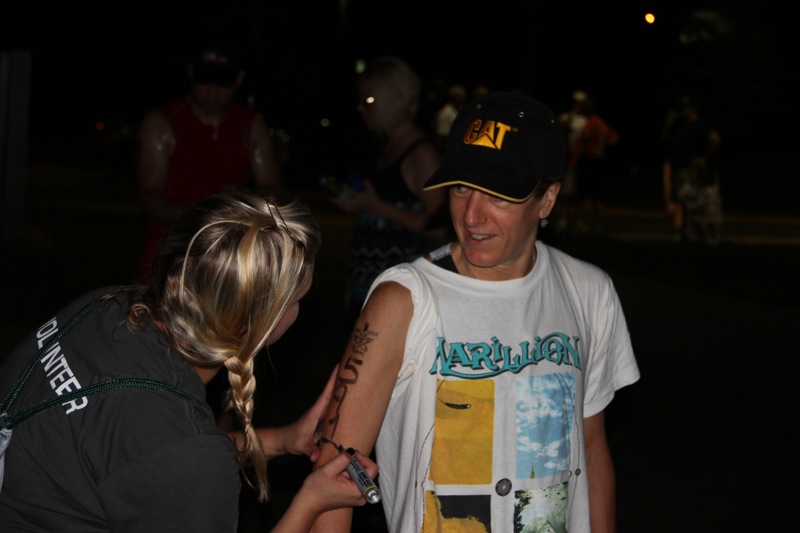
Getting body marked
Race day began after a fitful night with only a couple hours of sleep. Our hotel, the Residence Inn, was so close to the transition at Waterfront Park that we were able to walk there on race morning and avoid parking issues. Air temperature was in the 70s with a predicted high of 93 degrees F. I prepped my bike with nutrition bottles, dropped off my special needs bags, and we headed for the swim start (a mile away). I had no idea what to expect with the time-trial start, but by the time we got there, we understood why people started lining up at 2 a.m. Upon seeing the queue, I realized I would have to settle for a late start. Body marking came first, and then we started our trek to the end of the line.

It was a long walk.
We walked for what seemed like another mile before the crowd thinned out. I waited in the bathroom line while Julie headed to the end of the start line. She located a few Northeast Ohioans who were generous to let me jump in line with them. The plan was for all competitors to be in the water within 40 minutes starting at 7 a.m. We watched the pros swim by followed by early age-groupers. The line moved pretty fast, but its length gave me more than enough time to get into my swimskin (84-degree water meant a non-wetsuit swim), don my cap and goggles, and get hydrated and fueled. I reached the start just after 7:30. We were shuffled along and told to run along the dock and jump in feet first.

After a quick wave to the J-Team, my swim had begun.

descending to start
Right up until the point my feet hit the water, I had been wrestling with doing this Ironman. I was tired. Worn out. 140.6 miles had become such a daunting task. Especially after my all-out race last weekend. I had begun to believe my heart was no longer in it. But on Sunday morning, something happened when I hit that water. Something I hadn't felt in a long, long time.

I enjoyed it.

I was swimming in the Ohio River and I was having fun! I was expecting to hate every second of it, but instead, the water was not disgustingly dirty (as I had been led to believe), and the temperature was not too hot (as I had been led to believe). The time-trial start was more comfortable than the usual mass Ironman start. I didn't get clobbered instantly (don't get me wrong - I got clobbered, but not instantly). I had time to get in a groove while in the channel and there was no need to spot buoys because I could see exactly where I was (island on one side, river bank on other). The swim course rounded the island so that the sun is in your eyes only for a bit until you turn 180 degrees to swim downstream along the far side of the island, under two bridges, and to the finish line.

Out of the water and into T1
I stopped a few moments to gather myself after getting kicked directly in the face near the turn. Then I decided to swim wide for the remainder of the course. With the sun behind us and calm water, the yellow and orange buoys were ridiculously easy to spot - it was smooth swimming the rest of the way and I was very surprised at how fast it went by. I stayed relaxed and stretched out to get the most out of my stroke without further stressing my still-injured right shoulder tendon.

NO ONE on the planet was more surprised than was to look down at my watch and see a time of 1:00 when I climbed out of the water. I had expected 1:05 at best - more likely 1:10 because of the shoulder and lack of swim training. While running to the transition zone, a very uncharacteristic thought went through my mind: "I still got it baby!!" I was elated (and yet baffled by my own response). I decided to go with it - capture the energy - and ran into T1 with a purpose, lacking my usual fears.

See? I wasn't kidding.
I yelled my number, got my gear bag, and outran everyone to the change tent. The volunteers in the change tent were amazing. My shoes, number belt, and helmet were on in an instant. When I got to my bike, I realized there were a LOT of bikes still in transition. Thus, my swim had been very fast comparatively. I felt like jumping up and down screaming. I saw Julie. I saw Jim. I yelled "woohoo" like a 12-year-old, and got on my way. Seriously. Who the heck was I acting like? Certainly not me. This was NOT my usual M.O.

Whatever. My motto had now become... "just go with it."

And so I rode. I rode as I had planned to ride - relaxed, keeping my heart rate low and my cadence even. Navigating the rolling hills required concentration so that I didn't burn out my legs riding too hard on the uphills. A lot of people were getting out of their saddles on the hills. I kept my cool and rode easy.

The Ironman Louisville 112-mile bike course is easy to crush if you're accustomed to rolling hills. But it can also eat you up and spit you out if you don't ride conservatively. I met an athlete on Saturday who referred to the course as a "meat grinder." The shape of the course is a modified loop with a really flat first and last 10 miles and a short out-and-back done once before the loop begins. There are some formidable hills despite (I was told) being only 2000 feet of climbing altogether. I found that "climbing skills" are irrelevant on rolling hills, that being a good shifter and a good capitalizer-on-momentum is more important. And so (at Jim's urging) I tried to channel my effort intelligently into these two things.

Whizzing through LaGrange
Despite my concentration, I was still able to enjoy the atmosphere in Louisville during the ride. On one of the bigger hills, there were no less than three costume characters vying for our attention: the Grim Reaper (who came right up to bikers' faces to talk them into "going with him"), Superman, and the Devil (a.k.a. person-with-horns-dressed-in-red-satin). On another hill was a guy in a speedo wearing an American flag as a cape. This is great support and it certainly keeps the levity up. The looping part of the course took us through LaGrange where crowd support was enormous and they even announced our names to the throngs of people lining the street. It was during this stretch on the second loop that I finally saw Julie and Jim in the crowd, and it gave me what I needed - a huge burst of energy to get through the final 30 miles of the ride.

On the bike, I knew my fueling had to be perfect. I paid great attention to not screwing up this time. I drank three bottles of Gu Roctane and took five Gu Roctane gels supplemented by water, Gu Brew, and Ironman Perform to get 24-30 ounces of fluid per hour. I did one salt stick capsule every half hour. Even though air temperature rose as the day went on, I was never thirsty and never dizzy. I think the shade on the Louisville bike course kept the heat from overwhelming me, and the time-trial start forced me to ride my own race and not chase or try to lead anyone in my age group. For many miles, I leap-frogged with a woman in my age group: every time I passed her, she immediately passed me back, sped up to get way out in front of me for a few miles, then I would eventually catch her and start the entire cycle over again. Strangely, it didn't rattle my cage as all I did was make a mental note that it was happening.

With about 15 miles left on the bike, I started to wonder if I had rode too conservatively. It was ok, though, because I had to tax my system a bit on this last stretch which was into the wind. My back and hips had that familiar stiffness from being in the aero position for too long, but overall I felt relaxed and not overly tired. I was actually looking forward to starting the run and encouraged by the fact I had no nausea this time, even with the heat.

Starting the run
As I rounded the corner to the bike finish and T2, I saw Jim and I knew he would have some words of advice and know something about the overall age group situation. When I dismounted, I struggled to get my body to move in an upright position toward the transition bag area and shouted my number. I grabbed my bag and made my way to the change tent. The volunteer, again, was amazing in helping me get my pockets filled and on my way. Water and sunscreen were offered - I took both and was on my way. Going from hobbling to sitting to standing to running was easier than usual this time, but time would tell if I could hold it together. I saw Julie. I saw Jim. I was encouraged.

The first two miles of the Ironman Louisville marathon is out and back on a bridge. As I approached the bridge, I saw a woman in my age-group coming off the bridge. She was running strong and I wondered if I looked anywhere near that good. When I hit mile 1, I looked at my watch to see the split: 7:30. It was an uphill mile. Yikes! I needed to reign this in. I backed off. I hit mile 2 even faster. This was NOT GOOD. Then I saw Jim. Here's what he said: "Nick says you have a 20-minute lead in the age-group! Go easy!" and then he said the four scariest words: "All you have to do is..."

Get. To. The. Finish(Line).

Coming off the bridge near mile 2 - still smiling
Well, yeah. There's the rub. How many finish lines have I NOT seen this year? I had begun to question whether I would EVER see another Ironman finish line. I was two miles into my marathon, and I was already going down that mental path. I had to shake it off. What to do? Focus on getting from point to point. Ironman champ Chrissie Wellington says she focuses on running from aid station to aid station. Yeah. I could do that.

But it was so HOT. I focused on nutrition and getting ice and cold water on my body in as many places as possible. In my hat. Down my tri top. Down my SHORTS. I ran with ice in my hands. I poured ice water on my face. And it worked!

But there was one problem. My right inner thigh had started talking. It was angry. It was threatening to stop working. I paused a few times to stretch. I made sure I was supplementing with electrolytes. I walked only the aid stations and maintained a 8:15-8:30 pace. I saw Jim again at mile 14. He walked with me for a bit. He said that Nick calculated my age group lead at about 30 minutes. Don't worry about pace. And then those four words again.

Just get to the finish.

No nausea yet - only fatigue and that threatening pain in my leg. The special needs bags were waiting around the corner and to my delight, a volunteer was not only holding my bag, but he was holding out my bottle of Gu Brew for me. I almost cried.

With my trusty Gu Brew
I drank some of it and ran with it. By mile 19, I had passed the final woman in my age group (she let me know this - do all age-groupers do this?) and I was now leading out-right. But my race was coming unglued. My pace was falling to near 9-minute miles and my stomach was now angry. It was saying really mean things to me. I started drinking coke to shut it up - the sugar gave me energy for short bursts. With less than five miles to go, things were coming undone, my leg was cramping, and I needed a pick-up. That's when I made a major mistake. I was so sick of Ironman Perform and coke that I listened to THAT guy. You know, the guy who said: "try some chicken broth."

I would pay for that mistake. Coke and chicken broth DO NOT MIX. At an aid station with just over two miles to go, I was vomiting the contents of my stomach into a garbage can. And it wouldn't stop. I was bent over and started getting the shakes. If I stopped moving, things would surely fall apart in a hurry (because that's what they do in Ironman). Seeing me in distress, several athletes stopped to help. They poured cold water on me. They encouraged me. They were angels with running shoes.

And I turned and kept running. I had to stop several more times with the vomiting. Spectators encouraged me. You're at mile 14. Keep going. Hang in there. I couldn't muster the energy to tell them I was almost done. I stood up, jogged around the next corner only to see the sign: "finish straight ahead... second loop to the right."

Oh my God. WAS THAT THE FINISH LINE??? It was right in front of me!

I had almost given up the Ironman finish line. But Jim and Julie would be waiting for me there. Maybe friends would be watching online. So here's a little video of what happened next (the finish line camera captured by Nick with his Flip camera):


One of those hands was Jim's.

When I crossed the line, I proceeded to get sick one more time (obviously). I had a whole cadre of volunteers helping me move along and they finally put me in a wheelchair. I got all materialistic on them: where was my medal and my shirt and my hat? I must have them. I earned them. I was no longer that person in the medical tent not getting them. I finally finished another Ironman.

Julie and Jim stayed with me while I sat in the wheelchair and fought to overcome the lingering nausea and get some fluids in me. I had my own volunteer, an athletic trainer named Carol (or C.J.). We dubbed her a member of the J-Team - after all, her middle name started with J. While determining whether I should go to medical, it occurred to me that before the race, Julie said she would get a tattoo if I got a Kona slot AND stayed out of medical on Sunday. I was determined to hold her to it. Jim checked the live splits to find out that I had, indeed, won my age group at Ironman Louisville. I looked up at Julie and I said "Guess what!"

She laughed and replied: "We're going to Kona." (I guess she forgot the wager. But I'll hold her to it.)

The W45-49 Podium
ALL PHOTOS COURTESY OF TEAM PHOTOGRAPHERS JULIE AND JIM