Saturday, September 18, 2010

Where's the Personal in Personal Training?

What is a "personal trainer" anyway? Most of the people I know who have personal trainers describe them the way I would describe my high school sports coaches (back when coaches were bad-asses and we dreaded their wrath). A trainer's job should be more than just to whip the asses of people who lack motivation. Hell, many people can get that at their daily jobs. Why pay for it?

I don't know about you, but I can kick my own ass worse than any trainer can. Most of MY coaches spent their time trying to get me to back off and avoid injuring myself. When I say I don't need motivation, I know what I'm talking about. And when I tell a trainer what I need as an athlete, I also know what I'm talking about. If I hired a personal trainer, I would want him/her to understand my goals as an athlete and help me put together a plan to accomplish them.

My new gym membership came with a "free" session with a personal trainer. What they don't tell you is that "free" really means "you have no choice and we won't give you the option of turning it down." Ok, no problem, it's free, right? And I don't have to pay for it, right? Ok. I made the appointment. My trainer asked me what my goals were. I told him: "strength training for triathlon and endurance events - and I don't want to add muscle bulk."  My trainer replied: "I'll do some research on that before we meet." And YES, I DID believe him - I always start by giving people the benefit of the doubt.

My training session began with a questionnaire that my trainer filled out while asking me the questions. The first question (again): "What do you want to get out of personal training?" I replied (again): "strength training for triathlon and endurance events - and I don't want to add muscle bulk."

The second question (and I am NOT making this up): "Can you be more specific?" Umm, how much more specific CAN I BE?!?! My trainer looked at me expecting me to (actually) narrow down my answer. I said (for the third time): "strength training for triathlon and endurance events - and I don't want to add muscle bulk." He looked down and started writing.

I mentally checked out. I don't know what he wrote. I don't care what he wrote. I came to a quick conclusion: personal training with this person will do nothing for me. The rest of my session involved exercises with balls, chairs, weights and one machine. My trainer rarely made eye contact with me (people who know me will tell you this is one of my major pet peeves). After he mumbled instructions, I had to ask him several times to repeat himself. After giving me exercises, I had to ask him several times how many reps (there's that word again...). While doing exercises, I had to ask him several times "in which muscles should I be feeling this?" He never once asked me about my triathlon training and racing.

We ran out of time but he told me the last part of the workout was supposed to be "bike intervals." Bike intervals? Seriously? Then he asked me if I've ever done bike intervals. Seriously?!?? At the very least, he could have looked up "triathlon" in the dictionary.

Maybe it should be called "impersonal training." Or maybe they should send these people to "personable training." During my session, my trainer spent more time showing me what HE could do in exercises I could BARELY do. Is that the trick? They convince you you need a personal trainer by showing you things you can't possibly hope to do (the first time)? Sounds like job security to me.

And it's a good gig if you can get it. At the end of my "session" I found out personal trainers make a LOT of money. Even with the special "half price deal for signing up within 10 days of my membership." My "trainer" took me in a little glass-enclosed room and told me I needed 12 sessions. Really? What does that cover, 12 months? No. "Six weeks." You've GOT to be kidding. I gave the excuse: "I can't afford it" (this was more than partially true). The next step: "Well, what CAN you afford?" Think fast, Jeanne! "I can't make any financial decisions without talking to my husband."

Whew! Made it out of that one, mostly unscathed. I was not given an option to NOT make a second appointment - "to assess the first session and do the bike intervals." Then I suppose I'll give my final "no." God only knows what excuse I'll come up with then. Whatever it is, I'll have to live with it every time I walk in the door. And I know myself - I'll feel embarrassed and guilty every time I see him. Yes, even though I shouldn't. Which makes me wonder: does personal training extend to the mental realm? Because THAT'S the personal training I could really use.

Thursday, September 16, 2010

Risks and Payoffs

My morning run today gave me the idea for this blog. While I was pounding the pavement, I saw lightning in the sky and wondered to myself: was it stupid for me to run today knowing that there was a storm rolling in? It made me think of all the risks we athletes take on a daily basis, sometimes by choice and sometimes by accident, and how some of mine may be the very things responsible for making me the Disaster Magnet. Although, lack of common sense and not paying attention do not constitute risk-taking but also may be responsible for some of my disasters.

Some risks are merely the result of an overeager attitude (one of my fundamental personality traits). Some of these risks result in disasters. Some don't. One such risk was the one I took when I was a 14-year-old freshman on my high school track team. I didn't realize I was taking a risk that day when I ran an all-out quarter mile at my track coach's request. Everyone had to do it - no one asked why. This was back in the days when we ran "quarters" and not 400 meters, high school tracks were made out of something called "cinders," and anyone stupid enough to run an all-out lap would end up running that all-out lap in the first track meet of the year. How was I supposed to know that 70 seconds would seal my fate for the next four years? And it wasn't really a disaster -- not until I won that first all-out lap at that first track meet of the year. My "finish line lean" -- yet another risk taken -- threw me onto one of those cinder tracks in one of the most painful -- and most jubilant -- moments of my life. Disaster number one? Perhaps. A risk worth taking? Definitely.

I've learned it may be hard to assess the results of risks taken in the name of overeagerness. For instance, blowing up at the end of a half-marathon or marathon when you think you had your pace under control but went out too fast. A disaster? Sure. A risk worth taking? Yes if you look at the race as a learning experience. No if it's your goal race of the season. Then you should know better. The same goes for nutritional risk-taking in races. It's the reason why practice and B- and C-races are so important. There is no place for risky behavior in your most important event, so get it out of the way beforehand and learn what you're capable of by taking those risks when you have nothing to lose.

And then, some athletic risks are ones we take because we're just being stupid or obsessive. You all know what I'm talking about. Tell me, again, why you're running with that injury? Or why you're not taking the day off when you have a cold or fever? (You have pneumonia now? UM, how did THAT happen?) The problem is that we don't see the risk we take by running through an injury but instead see the risk of taking a few days off. Is there any other group for which pain is not seen as a warning signal from the body? Risking injury by ignoring pain was my disaster M.O. for years -- my marathon running was plagued by five tibial stress fractures in less than 10 years.

Which brings me to today's run. I took a risk. I took three days off from running after my race on Sunday. Will it affect me in Clearwater in November? The rational me says: probably not. The rational me says it was a risk worth taking because I'm burned out. Then I took another risk today. I checked the weather before I left the house and saw that there was a line of thunderstorms just about to hit. I ran anyway. The whole time I was out, I kept thinking "I can run in thunder and lightning, what could possibly happen?" And this is precisely why I may continue to be the Disaster Magnet. I see the potential for disaster -- I live in a neighborhood with a LOT of old trees in a town that has endured severe flooding. But I took the risk anyway. Was there a disaster? No. But that doesn't mean there won't be one next time. And you can be sure that I will blog about it.

Monday, September 13, 2010

You CAN Always Go Home: FIRMMan Race Report

Mom & me, prerace - look at that sky!
I know one thing for sure, home is where the heart is. By "home," I don't mean the house in Connecticut in which I grew up. I mean New England. And I returned to my home this weekend to finish up my regular triathlon season with a race that's very near and dear: the FIRMMan Half-Ironman in Narragansett, Rhode Island. The race usually attracts an excellent field of local athletes and is produced by Fiske Independent Race Management (F.I.R.M.), who organize more than 30 events throughout Massachusetts, Connecticut and Rhode Island.

The first time I did the FIRMMan was in 2002. I chose the race for two reasons: it was close to my family and I could use it as a warm-up for Ironman Hawaii. That year, the weather was stellar - sunny, in the 80s, and dry. I did my fastest times ever at both the 70.3 distance (4:35) AND the half-marathon (yes, it's true, my fastest 13.1-mile run ever was in a triathlon). I finished third woman overall that year, and after the race, my parents, my husband Jim, and I spent a nice few hours on the beach before we headed home to Cleveland.

The second time I did the FIRMMan was in 2004. Jim and I were going to be in Connecticut that weekend for a party, and I decided to give the race another shot even though I was not training seriously that year. I don't remember much from that year except that the weather was almost exactly the same as in 2002, I finished third, again, and we had a great time afterward with my parents, again. Sadly, it was the last time my dad would attend one of my races as he passed away from cancer the next year.

Despite great experiences, the FIRMMan was not immune to my disasters. Even though I had a great race in 2002, I had two classic Disaster Magnet-style mishaps on the course. I hit a pothole near the beginning of the bike course and lost my race nutrition bottle, and I took a wrong turn on the bike course and lost about 1-2 minutes. Then, when I attempted a third showing at the FIRMMan in 2008, the entire race was postponed until a later date due to a hurricane sweeping north along the eastern seaboard. We learned this after checking into our hotel in Narragansett.

This year, we had planned to stop in Narragansett for the FIRMMan before continuing on to Cape Cod for a vacation. But, as they say, the best-laid plans... Jim found out he has a torn meniscus and needs knee surgery so we decided to scrap our vacation plans because of his limited mobility. The trip was abbreviated to four days -- to drive, race, and drive home. But we did manage to pick up my mom and drop her back off in Connecticut on the way.

This year's FIRMMan would be the last opportunity to assess my training and tri skills before Ironman 70.3 Clearwater on November 13. I didn't plan much of a taper, but I did take several days easy before the race to get the feel of racing fresh -- something I hadn't done since Lake Placid in July. I dealt with my normal pre-race nerves in a different way this time. I drank two glasses of red wine the night before the race and I was out cold by 9 p.m. We woke up at 3:45 on race morning and got down to the start by 5:15. While it was still dark, I set up my transition, got body-marked and complained about the cold (it was around 50 degrees F).

The race takes place at Narragansett Town Beach with a 1.2-mile point-to-point swim parallel to the shore. I donned my wetsuit while we walked up the beach and got in for a quick warm up at the starting line with 10 minutes to race start. The water felt colder than the official measurement of 70 degrees, but it was warmer than the air. With overcast conditions, the day's high temperature would not reach 70.

Swim finish
Because I signed up in the "elite" category, I would start in the first wave with male and female elites and 50+ men. When it appeared I was the only female in the wave, I regretted the decision. All the other women started in the third wave, eight minutes behind me. In years past, the surf had been rough on the way out but the rest of the swim was relatively calm. This year, the opposite was true -- the deeper water offshore was rough and spotting buoys was more difficult than in the past. At the final turn, a course official directed me to "spot the building!" as the buoys were almost impossible to see and the current on the way in was sweeping athletes off course. I realized this when I reached the shore and several swimmers were running toward the transition from the far left. Despite unfavorable conditions, I had one of my faster swims and crossed the chip-mat around 25 minutes. There were very efficient wetsuit peelers just inside the transition zone, making my transition much quicker.
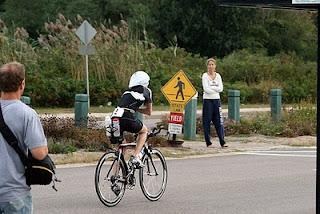
Bike start, adjusting my jersey
The FIRMMan bike course can be described as rolling New England hills and remains the site of my second fastest 56-mile ride ever. The air temperature was in the 50s for the start of the bike leg, and I found myself launching so many snot rockets even NASA would be proud (my husband thinks that would make a good name for a punk band). I was glad I decided to wear my bike jersey, but it did absolutely nothing for my feet which were blocks of ice for most of the ride. I was able to keep my average speed just over 20 mph until we faced a strong headwind in the last 15- to 20-mile stretch.

I spent most of the first hour of the ride jockeying for position with one of the 50+ male riders. He spent most of that time looking over his shoulder at me (or who-knows-what?). At the first major hill, I gave him the old Contador slip when he threw his chain. He eventually caught and passed me, and then I didn't see him again until the last five miles. When I finally caught him again, he had words of wisdom for me: "great way to come back!" (as though I had rallied to catch him). I didn't have the heart to break the news that it wasn't I who sped up, but actually he who slowed down. Only one woman passed me on the bike, but she was on a relay team and I re-passed her before the transition. At 2:46, my bike time was at least six minutes slower than I expected.

In transition, the announcer noted I was the first woman off the bike and on the run course. Neither he nor I had a clue on the performances of the women behind me. And I knew that if any of them were within eight minutes of me, I wasn't actually leading the race.

Which brings me to the run. If I had any designs on winning this race, I had to be at least eight minutes in front of the second woman by the time I finished the run. The run is on gradual rolling hills through neighborhoods and scenic by-ways. The only major hill - a steady incline - begins well before the first mile marker and doesn't end until after mile 2. This hill also leads runners down to the finish. Thus, my strategy was to run hard for 11 miles and follow it with a two-mile controlled fall. On the course, I would gauge my overall lead (if I still had one) at the two 180-degree turns when the course loops back on itself.

At the start of the run, I heard Jim say "relax - go out easy!" I heeded his advice and settled into my classic marathon shuffle step. Based on how I felt and a nagging sharp pain in my hip, I thought a 7-minute mile pace would be my best bet. After the first mile, the hip pain settled a bit and I split a 6:57 at mile 2, the uphill mile. It was at this moment I realized the potential for this to be my best run of the season.

The beach finish
At the first turnaround near mile 4, I kept an eye out for the second woman. She was about five or six minutes back. I had to stay strong. I alternated water and Gatorade at the aid stations with no walking. My goal was to keep every mile under seven minutes. I would have done it had it not been for one equipment malfunction -- my salt capsule container was catapulted from my tri shorts and I had to stop to retrieve during mile 8. By the second turnaround near mile 9, I noticed I was more than 10 minutes ahead of any woman I saw on the course.

The excitement of my lead got me through miles 10 and 11 and into the final downhill miles. This thrill came to a sudden end when I realized my memory failed me. The FIRMMan had one more trick up its sleeve before the finish line -- the "beach quarter." The final quarter mile of the run course is on beach sand. It's almost like acing a multiple-choice exam only to find out there are essay questions at the end. It felt like I would never reach the finish line, but then I was there -- and smiling. I finally hit that sub-1:30 half-marathon that I had almost given up on.

Awards ceremony
It didn't take long after finishing for me to start shivering in the cold. Jim confirmed that I had won the women's race while I changed into dry clothes and packed up my bike and wetsuit. The finish line included a awesome post-race meal (as always here) and luau. Then I remembered yet another awesome thing about this race. All the category winners get to choose their awards from a table full of "stuff" which this year included great items such as Tyr transition bags and triathlon clothing certificates from sponsor V3 Multisport in Arlington, Massachusetts. I chose a bottle of Hammergel that came with a QuintanaRoo wetsuit - you can't beat that deal! We spent a little time meeting and talking to other triathletes before it was time for us to head back to the hotel and get cleaned up so that the non-triathletes (Jim and mom) could have a little fun and dinner before we left Rhode Island.

And it's always hard to leave. Because it feels like I'm already home.

Friday, September 10, 2010

Oldest Person in the Room was Still Laughing: Demetri Martin at Kent State

Last night I had the great fortune to see my favorite comedian, Demetri Martin, live at Kent State University. I've been a Demetri Martin fan ever since the first time I saw him on YouTube doing a video for a song called "Selfish Jean" by Travis. Almost completely by accident that same week, I caught his stand up special called "Demetri Martin - Person" on Comedy Central. I was hooked immediately.

When people ask me to describe Demetri Martin's comedy, the only thing I can come up with is "Steven Wright with props," -- and then I wonder if that's an old-person reference. Does anyone still know who Steven Wright is? I'm guessing most of Demetri Martin's fans have not heard of him. Why? Because most of Demetri's fans weren't born when Steven Wright was popular. And they packed the Mac Center in Kent last night. I was acutely aware of being the oldest person in the building. Even the people I was with, my husband Jim and my good friend Elizabeth, were younger than me. Despite the fact that Demetri's is closer to 40 than 30 (although he looks more like 20), most of his fans are of a generation that demonstrate their enthusiasm by getting tattoos of him on their bodies (I am NOT making this up). One such fan had the pleasure of showing hers to the entire audience last night at Demetri's request. But it didn't matter how old anyone was last night -- Demetri made EVERYONE laugh.

Last night was my third time seeing Demetri live, and he was as funny as he's ever been. I was happy to see that every time I looked over at Elizabeth, a Demetri Martin virgin, she was laughing out loud. He did all the standards: the "Large Pad" (jokes that involve visual representation), the jokes with keyboard and guitar, and some new stand-up jokes. One of the funniest things he's doing lately is showing the audience a bunch of flyers that he made to put up in the local businesses or coffee shops. The photo to the left shows one of these flyers -- it says "I can see you right now. Call me to prevent me from getting you" but all the phone number tags are torn off. These are not just props. They're witty props. And oh my God! You have to know how to READ. Maybe that's why Demetri is so popular on college campuses.

The mark of a good comedian, in my opinion, is one who can develop a rapport with each and every audience no matter where he is. Demetri does this right from the start of every show by surveying his surroundings and making jokes about them. Last night, upon learning from the Kent State students that their main rival was Akron -- whose mascot is "a kangaroo" -- he cleverly noted the absurdity of it: "don't they know there are no marsupials in North America?"

But by far, my favorite part of a live Demetri show is the last 15 minutes or so when he "takes requests" from the audience. People shout out their favorite jokes and he performs them. Seriously? A stand-up comedian who takes requests? Even Demetri looks surprised when people shout out jokes he may not have done in a while. He even screws them up once in a while. And then laughs out loud at his own blunders. Elizabeth loved how he sometimes can't help himself and laughs at his own jokes. And isn't that what comedy is all about?


Wednesday, September 8, 2010

The Perils of a New Pool

Photo borrowed from moviehole.net
It's September, the month during which my local recreation center pool is shut down for maintenance and servicing for three weeks. The search for somewhere to swim in my local area sent me right to the door of a big chain health club/gym. Now, I know I should be thankful for finding a nearby place to swim, but after my workout this morning, I'm feeling judgmental (please note the term "mental" in there), so I'm going to make fun of health clubs (and by default, health club "types"). Any resemblance to actual persons or places, real or in the movies, is strictly non-coincidental.

Here's a little background information: I break into a cold sweat every time I get near muscle-bound body-builder types. It has something to do with my first experience in a fitness facility at age 15 when I was strength training at my swim coach's request. At that age, there were a thousand things I'd rather be doing in the evening than being scrutinized and chastised during workouts by men with giant muscular bodies and tiny heads who missed their calling as drill sergeants and whose only job qualification was to use the word "reps" in a sentence.

Thus, in case I collapsed from repressed fear, I made my husband Jim meet me at the health club. And it was indeed a good idea, because as soon as we walked in the door, I was struck with the inability to speak. I know this because when I finally worked up the courage to make eye contact with someone there, Jim was already pointing at me and saying (to the receptionist): "She's interested in seeing the pool." Within moments, I was being handed a clipboard and giving away my email address and phone number. All this just to look at a pool?

After signing on the line, the next step was to "take the tour." (But, seriously, can I just look at the pool?) We were greeted by a dark-haired muscular, well-groomed, bearded young man wearing the required slightly-tight polyester clothing that conforms oh-so-subtly to muscle curves. Yes, I notice these things. Yes, I'm stereotyping. I looked back at the sign on the door to make sure it didn't actually say "Globo Gym."

To be fair, this particular fitness center/health club/gym was not populated by beautiful people with tight bodies like in the TV commercials. The population (and cost) actually did look a lot more like Average Joe's -- the numbers occupying treadmills and machines were sparse at best. And they do have a boxing ring. But what about the pool?

We went to look at the pool: "It's 25 meters, a mini-Olympic size pool. It's three feet deep at one end and slopes to five at the other."

Me (mini-Olympic, wtf?): "Really? Wow! That should be great. I'm not used to swimming meters."

Gym guy: "What size pool are you used to?"

Me: "25 yards. Will it be difficult to get a lane? Are there usually a lot of people using the pool?" I note to myself that there are four lanes, not all occupied, each less than half the width of my rec-center pool. The lanes are so narrow I've decided butterfly is an impossibility unless I chop off my arms at the elbows. There will be no sharing of lanes here unless one person has gills. One lane is occupied by non-swimmers, and the club's whirlpool is adjacent to the pool (they could almost share the same water).

Gym guy: "No, I never see people waiting. The only time you'll have trouble is during water aerobics classes." He then assures me that morning and after-work hours will be no problem. And... "people can share lanes." Hmmm, has he actually seen that? I'm guessing he doesn't go near the pool often, but I could be wrong.

All things considered, I decide on a month-long membership to start, if just for the pool. And cool, they throw in a free session with a trainer. Maybe, just maybe, this will be my big chance to learn about strength training for the winter. And for the bike.

Fast forward to this morning -- my first workout at my new pool. I grab a locker, get out my pull-buoy and hand paddles and walk onto the pool deck. I'm instantly aware that this is NOT a place for someone as self-conscious as I am. I may be the first person who knows something other than sidestroke to step foot in this pool. I start swimming. I'm instantly aware that three feet is barely enough depth for my hands to clear the bottom. Flip turns at this end will be interesting, if not painful. I come to the wall at the far end. I'm instantly aware that this is NOT a 25-meter pool.

Ok ok ok ok (spoken like Joe Pesci's "Leo Getz") -- call me a POOL SNOB, but here's where the tiny heads come in. Do NOT tell me a pool is 25 meters if it isn't even 25 yards! I can understand the meters vs. yards mix-up, but come ON! This pool is not 25 of anything! Maybe this place has no concept of measurement units unless they involve weight.

I get over the frustration quickly and regroup. I need to get my workout in. On the return lap, I am instantly aware of being watched. A man in the whirlpool is half-way out of the water, bent over the lap lane watching me. This is a little too close for comfort. I decide to breathe on the other side. I get on with my workout, keeping an eye on the people who come and go to the pool. I mean, the whirlpool. And the steam room. And the sauna. It's 6:30 a.m., is this a pre-workout steam? I decide to stop looking.

It's going to be a long September. Do you think they have a dodgeball team?

Saturday, September 4, 2010

The Importance of Being Geeky, or "How I Conquered the Columbus Marathon"

The fall marathon season is upon us. And, surprisingly, upon ME. As I vaguely remember, in the midst of a red wine haze on Thursday evening, I declared to my "running" friends that I would indeed attempt a marathon this fall. I call them my "running" friends because they're my awesome friends from my "running only" days who still want to hang out with me even though I went over to the dark side (triathlon).

So... this whole marathon thing got me to thinking about the "olden days" when I used to run a marathon as my goal race of the season. Every year, that was my shot at glory, to get my best time of the season in a race that lasted ONLY around three hours, hopefully (for me). Every year, the disappointment of running great splits right up until the wall, and then begging my body to hang on for five or six more miles. Every year, thinking I could run at least five minutes faster, and then being ecstatic to shave off, maybe, 30 seconds. And every year, wondering what the hell I was doing at the same starting line of the same race. Again.

That "same" race was the Columbus Marathon in Columbus, Ohio. It's a course made for a P.B. (personal best) that used to be held at at a time of year made for a P.W. (personal worst). The time of year was mid-November in Ohio when all hell could break loose, and did, when it came to the weather. One year it was in the 80s. One year it was in the 30s and snowing. One year it was in the 20s with a windchill of 0. Tall tales from THAT year have reported windchills well under -20 degrees F. THAT year was the year I learned that you can, indeed, grow icicles inside your clothing. But despite the weather, I continued to enter the Columbus Marathon many times in the last decade of the 20th century. And it was in the repeat running that I truly learned the importance of taking splits and being a "geek" runner (or mad scientist).

I tell anyone who wants to see their running improve to make a conscious effort to record splits in all their races. Even the bad races. Afterwards, no matter how painful it is, WRITE THEM DOWN. Then, if you must, hide them until you're able to look at them again without crying (kind of like photos of an ex). I've done this religiously for the past 20 years. I have two full "split books," most of which are lists of numbers (mile times) surrounded by textual rantings about how horribly wrong my race went. But even then, when I look back, I find lessons about attitude and what to avoid on certain courses, and sometimes - just sometimes - I figure out how to run that P.B.

And that's what happened in the Columbus Marathon. In November 1998, I decided to run Columbus less than a month after a disastrous attempt at the Chicago Marathon. I needed a pick-me-up (see a pattern here?). I pulled out my split book and Microsoft Excel (this may well be the ONLY time I ever mention Microsoft in a positive light) and plotted my mile splits from 1994, 1995 and 1996. It looked like this:


I've plotted my mile splits for many races, and my best races are the ones for which this chart is pretty much a flat line (i.e., even splits). For Columbus, the first thing I noticed - besides the fact that I run slow first miles, go out too fast, and hit the wall around mile 21 - was something very funky going on around mile 18. Was it just in the Columbus Marathon? I checked other marathon splits... yep, only Columbus. Could it be a hill? Impossible. There ARE no hills in Columbus. In fact, there are very few hills in the entire state of Ohio. I decided I would keep an eye on that point in the race... and try not to go out too fast.

If there's one good thing about being analytical, it's that it takes the emotion out of running. And in Columbus in 1998, I needed to approach the race with no emotion. I had wasted all my emotional energy that year in Chicago in one of my worst marathon performances ever. I had run on less than 3 hours of sleep in the two days leading up to the race. Needless to say, disaster struck.

Columbus had to be different. I approached it with a level head (read: emotionless) and ran not only my fastest marathon by four minutes, but one of my most even-split marathons (to that point). I ran smart, with a plan based on reviewing mistakes of the past. And not surprisingly, I found out exactly what happens at mile 18. It's a dead zone. It's the only point on the entire Columbus Marathon course with no crowd support. When I realized it, I focused on my pace and got through it with no problem. I plotted my splits on the above chart and now it looked like this (note the purple line):


Sure I hit the wall. But I didn't run a slow first mile. And I didn't go out too fast. And I'm sure you can draw numerous other conclusions about both me and the Columbus Marathon from the graph. But I wanted to focus this blog on the race plan I could formulate to conquer the course based on past "concrete" experience (not just my clouded memory). My advice to my readers: remember to record the data. Then USE the data.

In eight days, I will return to another race I've done more than once, the Firmman Half-ironman in Narragansett, Rhode Island. It's a race I'm very fond of for many reasons: it's near where I grew up (Connecticut), it's the only triathlon my parents ever saw me race (and the last race my dad was ever at), it's the course on which I did my half-ironman P.B. (and, interestingly enough, ran my fastest-ever half-marathon), and it's the site of one of my famous disaster stories (in 2008, the whole race was canceled because of Hurricane Hannah). Will I be reviewing my splits from years past? You betcha. There's lots of history. And lots of opportunity. And hopefully, at least one good blog story.

Wednesday, September 1, 2010

The Funk is Outlasting Steps Forward (Except on the Bike)

It's been five weeks since Ironman Lake Placid and I'm still unable to shake the funk. Sure, I've had some successes in local races, but those felt more like desperation maneuvers on my part -- attempts to pull something positive from all the work I did before Ironman -- you know, so I don't have to look back at a wasted season.

I had an interesting conversation with one of my biking partners this past weekend. It involved my lack of improvement on the bike even with the massive amount of hard training leading up to the Ironman. I seem to have reached a biking plateau despite working my butt off. And I'm not going to lie -- I was very disappointed with my performance on the bike in Lake Placid. In 2009, I rode a much harder course at Ironman Coeur d'Alene but my time was only a few minutes slower there. Was I was holding back? Or did I really have no improvement whatsoever after a year of harder training? I'm still evaluating and coming to grips with it. At Lake Placid, I planned to go "easy" on the bike, but I still expected my time to be, at the very least, ten minutes faster. In actuality, it was about three minutes faster. It's hard to get psyched to do more work on the bike when there are no gains.

The improvements, instead, were in the two sports I spent the least time in. How does THAT happen? My swim time in Lake Placid was even faster than expected. Although, sometimes I think my swim is governed by some unknown force in the universe because despite spending very little time in the water, I often pull a fast swim out of nowhere. I've just never been able to justify swimming more than three workouts per week knowing it's less than one tenth of the total race time.

So, in preparation for Clearwater 70.3 in November, I've concentrated on speed work in all three sports, and, as usual, my swimming and running are the only places I've seen any obvious improvement. As a former competitive swimmer, I know how to "whip" myself into shape -- it's easy to do by imagining my swim coach's face screaming at me. In three weeks, I've managed to get my 100-yard pool intervals down to a time I've not seen since college days. Maybe I'm reading the clock wrong. Or maybe it's my vision. (There's that age thing again, as I recently needed my first pair of reading glasses.) But, even so, I do "feel" faster in the water.

My hill run repeats have also shown surprising improvement, unless age-related memory loss has also been plaguing me. Maybe I'm choosing different start and finish points from week to week. Or maybe I'm reading my watch wrong (there's that vision thing again). But even if that were the case, I can still convince myself that I feel better each week even after increasing the number of repeats.

Yet, I feel like I'm stuck in a post-Ironman-depression funk, and I'm worried it's related to bike speed. I'm beginning to dread that bike leg of the 70.3 -- you know, the one that "should be the fastest of my life" because of the ridiculously flat course? You know, the one that, last year, was my fastest 56-mile ride ever? It's the same one that turned out to be slower than 50% of the people I was racing against. These thoughts are now occupying my brain on a daily basis. They're sharing time with the fear that I've made a terrible mistake signing up for another Ironman in May of next year.

And now one more thought is creeping in: it's going to be a long winter.

Friday, August 27, 2010

The Long Road to Nutrition Self-discovery

I have until next May to come up with an Ironman race nutrition plan that will work for me. I guess it's not the whole Ironman that I have to come up with a plan for. Just the run part. Or maybe just the heat part. Oh heck, I guess I have to rethink the whole race.

In rethinking "the whole race," I have to start by analyzing exactly what went wrong nutritionally during the run at Ironman Lake Placid five weeks ago. All my fueling up UNTIL the run seemed to be working great. Even up until the SECOND HALF of the run. There were no obvious warning signs -- no extreme fatigue, thirst, or lightheadedness -- until it was too late. Even the vomiting I did around mile 15 did not give me the sense there was a larger problem. But in analyzing the data, I've narrowed it down to two causes: hyponatremia and an overly-aggressive run pace. They were probably co-conspirators in my take-down.

I didn't just pull these two things out of thin air. I read. A LOT. I thought about my nutrition issues. A LOT. And I had help. My friend Jo-Lynn is a nurse and an honorary member of the J-Team. She took the scientific approach and explained what was going on with my stomach when it "shut down." I also have a friend who told me where to take a second look -- at my "run splits." After a 100-mile ride in 90-degree temperatures, Julie (J3) is convinced it was "the heat." I took all these things into consideration, looked back at my training and racing nutrition in the recent past and started to draw conclusions.

Starting with when things began to look "not quite right" in Lake Placid -- I guess it was that mile 15 or 16 of the marathon. I think I misdiagnosed my first bout of nausea and vomiting as caused by eating/drinking too much (a.k.a. the dreaded "sloshy stomach"). It was more likely the beginning of my stomach shutting down. Vomiting appeared to solve the problem because I already had enough hydration in me to last several more miles. But everything I drank after that never got into my system. Thus, when I had my seemingly unending "vomit-fest" at mile 20 and when I was diagnosed with "dehydration," the underlying cause was probably hyponatremia. I didn't just need more fluid, I needed more salt to help me absorb the fluid and balance the electrolytes in my system.

I've been aware of this thing called hyponatremia since 2008 when I was training for the Philadelphia Marathon. During that time, I would vomit during most of my runs over 2.5 hours, and I usually vomited at the top of the last hill (after fatiguing my legs the most). I was baffled. I never had this problem when I trained for marathons in the 1990s (in my 30s). I did some reading, learned about the condition, added electrolytes to my training runs and the problem went away. I concluded my body chemistry had changed over time, and I was sweating out more salt now that I was "old."

Of course, the hotter the weather, the more we sweat, the more we need to replace fluids, and therefore the more salt I need. Not everyone will have this problem. Jo-Lynn wrote in her assessment: "All people's body chemistries are different and Ph's slightly different, sweat rate, and sweat composition." It's not my sweat rate I'm worried about, it's the saltiness of my sweat. How do you measure that? You can measure how much fluid you lose in a run by weighing yourself before and after, but how does one determine how much salt is needed? Is it just trial and error? Is there some kind of salt litmus paper?

The kicker came in a half-iron triathlon race I did last weekend. I got off the bike in relatively cool temperatures and then the sun came out and turned the heat index up to about 84 degrees F. I had forgotten my Hammer Endurolytes, so I replaced them with the brand "Salt Stick" which we were told had five times the amount of sodium. I took one near the beginning of the run, but about half way through, I started to feel nauseous again. I slowed my pace, drank only sports drink and took an Endurolyte at an aid station -- that pretty much cleared up the problem.

So, then, why do I also think an overly aggressive run pace added to my problem in Lake Placid? Because in looking at my splits, I was out way faster than I had planned. I was attributing it to the downhills, but near the beginning of the second loop, I did start feeling a little pain in my quads that might suggest I was running too fast. This also messes with your fluid absorption rate -- blood is shunted away from your stomach for use in other muscles. I think it was a contributing factor in the early part of the marathon.

What do I do now? Many have suggested I stick with short races (like I'm going to listen to THAT). Jim still has plans to get me a nutritionist. I started by buying a book. It's called Sports Nutrition for Endurance Athletes by Monique Ryan. It covers so many different aspects of nutrition that I figure, even if I still need help with the actual race nutrition plan, this book can help me work through other nutrition aspects of my life. Like that supplementation issue that I can't quite figure out and often spend entire days on the computer looking for the perfect dietary supplement to get me through a long day at work and two long training sessions that include speedwork. If you know of that drug, and its legal, please contact me... but don't tell everyone else about it. I need SOME kind of edge. But make sure it also contains salt.

Monday, August 23, 2010

Of Lists and Triathlon Basics: Great Buckeye Challenge Half-Iron Race Report

The black cloud appears to be lifting. I say this not because I just celebrated my second triathlon win this year, but because I won despite everything I did to sabotage my own race. And as the Disaster Magnet, I always pay for my mistakes, no matter how small they are.

The race was the Great Buckeye Challenge Half-Iron in Springfield, Ohio, and I decided to race it just six days ago. And oh, did I make mistakes. I made easy mistakes that other people also made. I made stupid mistakes that were all mine. And I made those "you-should-never-show-your-face-on-the-triathlon-circuit-again" mistakes. But despite all of them, for the first time ever, I led the women's race out of the water to the finish line. The only explanation I have for it is that something must be amiss in the galaxy.

The mistakes began the day before the race with "the list." "The list" is my pre-race equipment checklist. Every race trip begins with printing out "the list." I learned the value of keeping such a checklist when I was a little girl. My father put me in charge of the checklist for our family camping trips, and I would proudly read it off once the car was packed -- checking off the "essentials" (tents, stakes, fishing poles, sleeping bags, flashlights, propane tanks, etc.) and the "non-essentials" (my teddy bear). One year, after I announced "everything is CHECKED!" we drove about a half-mile down the road only to realize we had left my mother in the driveway. The next year, as expected, "mom" was placed on the checklist. We never forgot her again. Because we used the checklist. Properly.

This weekend, I failed to use "the list" properly -- you could say I failed to use "the list" at all. It started when we pulled out of the driveway Saturday afternoon without my bike helmet (I noticed it was not attached to my transition bag). The first thing out of my husband Jim's mouth: "Isn't it on the list??" My reply: "Yes! But.. but.. I assumed we HAD all the bike stuff" (this was me trying unfairly to displace blame). We turned around, not without Jim's eye-roll, and went back to get it.
  • Listmaking for dummies, tip 1: make a list to eliminate "assumptions"
I soon paid the price for trying to blame Jim for the helmet. After arriving at the race site, Buck Creek State Park, checking in and seeing the [sandy] beach, I realized I also forgot my water bin for washing off my feet in transition. Jim: "Isn't it on the list???" Me: "Yes, but I meant to grab it on the way out."
  • Listmaking for dummies, tip 2: check things off the list only AFTER they are accounted for
We would have to find a store and get another water bin. We went to the hotel. After checking in and getting settled, I uncovered my third "list failure." This one was perhaps the most devastating of all. I had packed all my nutrition requirements except one: my electrolyte capsules. I made this mistake after four weeks of analysis concluding that not enough electrolytes was one of the major causes of my dropout at Ironman Lake Placid. Unbelievable.
  • Listmaking for dummies, tip 3: highlight the most important things to make sure you don't forget them (also known as the "common sense corollary")
Forward to race morning. I should have known something was seriously wrong when I got more than five hours of sleep and woke up refreshed. This "something" is what my husband later described as my "lackadaisical attitude" about the race. We drove to the race site, I picked up my timing chip, got body-marked and then set up my transition. Meanwhile, Jim bought two small packs of electrolytes capsules and everything was good to go. One odd thing about this particular race was we had no bibb numbers, and in setting up my equipment, it was weird to not lay out my race belt.

The 1.2-mile swim was a two-loop long rectangle course parallel to the shore in a beautiful man-made reservoir. The weather started overcast and foggy, the air was cool, and athletes were staying in the water to keep warm. According to race officials, the water temperature was "wet-suit legal." During warm-up, I heard another athlete exclaim: "I don't care how warm the water is, at least my legs will be floating." I kept my wetsuit on thinking the temperature "out on the course" would be cooler. It wasn't. It was warmer. And rough. By the time I finished, my biggest surprise wasn't that I was leading the women's race, but that I hadn't vaporized from boiling in my wetsuit.
  • Listmaking Triathlon for dummies, tip 1: if the water is [too] warm, don't wear a wetsuit, even if you do need it to "float" your legs
At over 33 minutes, my swim time was much slower than anticipated. (Many athletes would later commiserate about swim times up to 10 minutes slower than expected.) The swim was followed by a long uphill run from the beach and into the transition zone. After getting my wetsuit off in record time, I made my first stupid mistake at the bike rack. I unracked my bike before putting on my helmet and sunglasses. Note: if you place your helmet and sunglasses on your aerobars and unrack your bike, you will throw your helmet and sunglasses across the transition zone. What was I THINKING? Answer: I WASN'T thinking. I tried to blame it on not having a race belt to grab, but the problem was that I was not focused on what I was doing. I stopped, took the time to curse at myself, give Jim "the look" (something I didn't realize I did until he told me afterward), then picked up my helmet and sunglasses, put them on and made like Usain Bolt for the transition exit.

The 56-mile bike course was two-loops on rolling country roads with traffic. There were two other triathlon distances using parts of the same course. Intersection traffic was controlled by state troopers, but intersections were not always marked or manned, and directions were sometimes on the road and sometimes on A-frame signs. I fell victim to one of those unmanned intersections. Following the 40K instead of the 56-mile bike course I followed the state troopers' directions when they pointed left. I was supposed to go straight. I asked a 40K biker who informed me of the mistake. I lost about two minutes for the blunder. And yes, it was MY mistake. I glanced at but didn't study the course map before the race, and I could have paid closer attention to the arrows on the road. After the race, I was relieved to learn I wasn't the only one who made that error.
  • Triathlon for dummies, tip 2: read and understand the course maps before the race
At the bike turnaround, I was surprised to see I was still leading the women's race, especially since I'm a weak biker who went off course. But the next women were less than a minute behind me. Expecting to be passed in the second loop, I started asking myself the hard questions: Should I hold back and save my legs for the run? Should I try to maintain the lead and hammer?

I held my pace (around 20 mph) and waited. After a turnaround with about 10 miles to go, I saw the gap had shortened and the women were closing in. I made a decision. This might be the only chance I ever get to lead a race from start to finish, and that's what I wanted to do. I hammered the last 10 miles and pulled into the transition zone with my second fastest half-ironman bike time ever and only about five seconds in front of the second woman.

My bike-to-run transition went better than usual, but it still wasn't fast. I gave the second woman the slip when she sat down to put on her running shoes.

My run start was the scene of yet another bizarre blunder. The sun had come out and the temperature was rapidly approaching the 80s. I popped an electrolyte capsule in my mouth assuming there would be a water stop on the way out of transition. I mean, come on, what half-ironman race doesn't provide water on the way out of transition? The answer: this one. Upon the realization, I went to spit out the capsule but it was a nano-second too late. It dissolved and my mouth instantly turned into a salt mine.
  • Triathlon for dummies, tip 3: don't put anything in your mouth that requires water unless you actually have the water-stop in sight
The 13.1-mile run was a two-loop course on a paved multi-purpose path. My run started out a little fast -- I clocked mile 2 at 6:20 but then slowed to a 6:45-7:00 pace. By the second loop, the miles were no longer marked, and I stopped caring about how fast I was running when I saw I had a substantial lead. My run time was about 1:35, my total time around 4:52, and I was seventh overall and first woman.

It was obvious that everyone was struggling with the the heat on the run. There were aid stations with water, Hammer HEED, Hammergel and fruit, but there was a severe lack of man-power. The last aid station before the 3.2-mile turn-around was completely unmanned, and therefore, self-serve. I have never seen anything like it. The supplies were there but had not been unpacked. Cups and ice were still in plastic bags and the water and HEED jugs were not marked. It was a disaster with people desperately searching for what they needed. If you, like me, had planned on running through the water-stops, it all ended there. I just hope they didn't run out of supplies before the last runner went through.

I enjoyed hanging around after the race for a bit and met some of the other athletes. I especially enjoyed talking with two of the top men, Jason from Hudson, OH and Jun from Columbus. Sometimes, being able to celebrate and/or commiserate ends up being the best part of a race. It's when you realize, as athletes, we're all pretty much the same.

The Springfield, OH, Chamber of Commerce made a little video of the race containing interviews with the men's winner and yours truly:

Sunday, August 15, 2010

Disaster Recovery Part 2: Figuring Out the Dehydration

It's been three weeks since I crashed and burned at Ironman Lake Placid. The crash: with six miles to go in the best race of my life, I lost all my cookies (read: fluids) at an aid station, then stumbled one more mile to collapse from severe dehydration at the next aid station. The biggest questions in my mind are still there: Why was there no obvious warning? and why did I seemingly have no chance for recovery?

I've been analyzing what happened over and over in my head since the moment I arrived at the finish line in the ambulance. I asked the medical staff there -- the only answer they gave me for the vomiting and dehydration was that my stomach just "shut down." Why? "It just happens sometimes." Not good enough. I need a reason. This absolutely cannot happen again.

I came up with three causes of stomach shut-down: I ate (or drank) too much, I ate (or drank) too little. I ran too hard. Ok, that's really five causes. And there was a sixth: I didn't get any sleep the night before the race (as I've said many times, no sleep almost always translates to GI issues on race day). Then there were seven: too much water, not enough electrolytes. Eight: not enough water, too much electrolytes. Cause number nine? Anyone?

Basically, there are so many possibilities, it seems impossible to narrow it down. What if it were a combination of things? Now I want to tear my hair out. Am I the only one who has these problems? How could I have trained for it? All my long bike-run sessions went just fine with the nutrition I chose. No vomiting, no dehydration. I even ran a marathon in May to test myself. Will it now be necessary to do a full Ironman in training to test my nutrition and hydration plan?

I guess I have to start somewhere. The search for a nutrition reference has commenced. The first thing I did was Google "stomach shut down ironman" and the first reference that turned up was this: Competitive Ironman Nutrition Planning. There it was, in black and white:
If your stomach “shuts down” during the race you either 1) went out too fast - poor pacing strategy/control, 2) ate too much solid food, 3) did not take in enough water, or 4) are becoming hyponatremic (low blood sodium level).
In all honesty, I don't think I ran too hard. That's the one thing I'm relatively sure of. Well.. maybe 90% sure. So I'm going with it being a nutrition issue. Another reference online suggested, for another athlete's similar situation, that signs point to "dehydration or electrolyte imbalance." I guess I'll start there. In 2008, at age 43, I started experiencing regular vomiting during my long runs while training for the Philadelphia Marathon. I had never had that problem before. Research concluded it was caused by hyponatremia -- increasing my electrolyte intake during long runs took care of the problem. My electrolyte requirements had somehow changed with age, and I could no longer do a 20-miler with only water as I did in my 30s. Perhaps the electrolyte issues continue to increase with age -- I wonder, when I'm 50, will I need to add Marmite to my diet and put soy sauce on everything I eat?

My husband is pushing for me to find a sports nutritionist. I guess that wouldn't hurt either. And maybe I should find a sports psychiatrist while I'm at it.